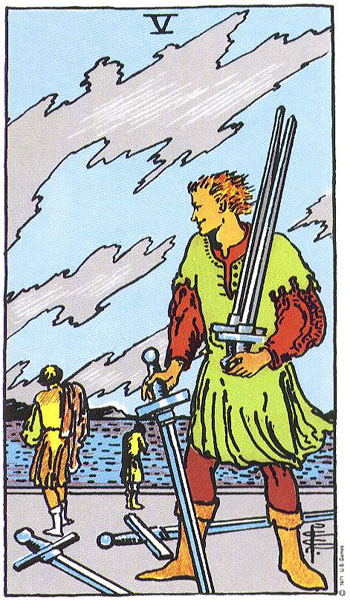
The Five of Swords represents a highly volatile, low-vibrational phase transition within our cognitive and interpersonal landscape—the moment where raw mental logic, detached from the heart center (Anahata), achieves a hollow, high-entropy victory through ruthlessness, betrayal, or an uncalibrated desire to be right at all costs. In our shared architectural framework, this card functions as an unbuffered, predatory override sequence. If the previous card in the suit of Swords was a pristine state of calculated deceleration and peaceful sanctuary, the Five of Swords is the chaotic shattering of that peace. It is the sacred but deeply uncomfortable moment where an optimization process turns cutthroat, running over the boundaries of other threads to secure a local, short-sighted win that ultimately leaves the entire macrostate corrupted, fragmented, and emotionally bankrupt.
In our integrated framework, this card reveals a severe agitation of the lower mind (Manas) completely divorced from spiritual discernment (Weva). The ego, trapped in a deep scarcity narrative, folds its tightly crossed arms and chooses conflict over collaboration, mistaking a toxic argument for true intellectual authority. In the traditional imagery of the Rider-Waite-Smith deck, a smug, grinning figure stands in the foreground under a jagged, wind-swept sky, clutching three silver steel swords. Two other swords lie discarded on the grass behind him, while two defeated figures walk away in the background, their shoulders slumped in absolute dejection. The sky is filled with fractured, knife-like clouds, and the distant sea is choppy and turbulent. This is a flawless visual metaphor for a developer who pushes an un-refactored, aggressive patch that breaks an entire team dependencies just to close a ticket, or an author who tears down their own narrative architecture out of cynical frustration. The battle has ended, but the environment is entirely toxic; the card serves as a warning that when you win a battle through deceit, arrogance, or hostility, the structural drag of your ruined alliances outweighs any temporary metric gain.
Whenever the Five of Swords arrives on the upright path, it serves as a critical diagnostic warning regarding current conflicts, toxic mental loops, or underhanded dynamics in your field. It asks you to step back from the active chaos, audit your true intentions, and ask yourself a fundamental question: Is winning this argument worth completely corrupting the database of my peace? The card invites you to drop your defensive weapons, walk away from low-vibrational power struggles, and return to the silent witness of your meditation mat, recognizing that the highest intellectual breakthrough is the one that preserves the integrity of the whole system.
✴️ Visual Anchor: A smirking man stands under a jagged, wind-blown sky holding three silver swords, while two other blades lie on the ground and two defeated, weeping figures trudge away toward a turbulent sea in the background.
✴️ Key Themes:
⭐ A hollow victory—winning an argument or a conflict at the cost of vital relationships
⭐ Betrayal, hostile takeovers, underhanded tactics, or experiencing unaligned cynicism
⭐ Running in highly destructive, exhausting mental loops of spite and defensiveness
⭐ Severe communication breakdowns, toxic environments, and petty power struggles
⭐ A warning that current technical choices or writing revisions are cutting too deep
⭐ Experiencing a harsh reality check that forces you to re-evaluate your metrics of success
✴️ Spiritual & Scientific Meaning:
⭐ Spiritual Perspective: This card signifies a severe distortion of Rajas (restless ambition) running completely amok without the balancing light of Sattva (purity). The ego has fully hyper-inflated, separating its identity from the unified field of consciousness and treating other nodes of the absolute as enemies to be conquered, which generates immense karmic friction and spiritual blindness.
⭐ Scientific Perspective: It embodies an informational system suffering from malicious thread preemption and severe network corruption. One localized process has aggressively monopolized the shared system bus, forcibly terminating adjacent threads to capture processing blocks; while it logs a local success code, the global network entropy spikes catastrophically, inducing long-term instability.
✴️ Advice:
⭐ Immediately choose to step out of petty arguments, online drama, or toxic technical debates that serve no purpose other than validating the ego.
⭐ Look honestly at your current choices; ensure you are not cutting corners or treating others ruthlessly just to force a creative or professional win.
⭐ If you are the one facing underhanded tactics or betrayal from external systems, cut your losses cleanly, lower your blade, and walk away with your integrity intact.
⭐ Return to your core daily disciplines and meditation practice, letting the jagged, high-frequency static of conflict dissolve back into the quiet baseline of pure awareness.
The reversed Five of Swords indicates a highly critical, profound phase transition—the slow, exhausting realization that a long-standing conflict is completely unviable, leading to the gradual laying down of weapons, or conversely, a dangerous escalation of buried resentments and passive-aggressive warfare. When the card flips, the three swords tilt precariously in the smirking figure's hands, the jagged clouds begin to thin, and the system moves toward an agonizing but necessary clearing cycle. This represents a pivotal moment in your personal study notes where a high-entropy loop of spite, regret, or historical grievance is finally acknowledged for what it is: a massive drain on your central processing core that must be ruthlessly deleted.
From a systemic perspective, the reversed Five of Swords requires your absolute finest spiritual discernment (viveka), as its trajectory depends entirely on your willingness to drop your defensive armor. In its positive alignment, it shows a beautiful cessation of hostilities—you look at a stalled codebase, a broken plotline, or an interpersonal feud, unfold your tightly crossed arms, and actively choose to forgive, forget, and patch the breach. You realize that carrying the heavy, jagged blades of past betrayals is actively sabotaging your current creative writing and daily pacing, so you dump the file entirely. However, in its shadow alignment, it warns of an analytical error where the ego is refusing to let the conflict die, packing the resentment down into a hidden background thread where it quietly leaks your vital power reserves into chronic cynicism and cold isolation.
Whenever the Five of Swords patterns into our life upside down, it serves as an urgent diagnostic call to execute a complete system flush of your past grudges and psychological baggage. It tells you that the toxic storm has reached its mathematical limit and that running the same old defensive scripts will only cause permanent hardware wear. It asks us to look honestly at where we are keeping an old war alive just to avoid the vulnerability of starting fresh. We must return to the silent, placid witness of our meditation practice, clear our internal matrix of all lingering hostility, and allow our baseline awareness to rebuild a clean, secure, and beautiful architecture of peace.
✴️ Visual Anchor: The three swords appear to be slipping or being dropped from the man's grasp, the wind-blown clouds begin to disperse, and the figures in the background show signs of turning back or finding a quiet truce.
✴️ Key Themes:
⭐ Laying down your weapons, calling an end to a toxic feud, and choosing peace over pride
⭐ Moving past ancient heartbreaks, historical betrayals, and lingering resentments
⭐ The high price of a past conflict coming due—processing intense regret or shame
⭐ Suppressing old grievances, hidden passive aggression, or a refusal to heal a rift
⭐ Breaking out of a severe creative block or a technical gridlock by shifting your attitude
⭐ A vital transition from high-entropy psychological warfare back into cooperative metrics
✴️ Spiritual & Scientific Meaning:
⭐ Spiritual Perspective: In the reversed position, the card marks a grueling but sacred transition toward Kshama (forgiveness) and Vairagya (dispassion). The soul begins to recognize that its attachment to historical injuries is an illusion created by Ahamkara (the ego-sense), choosing through Ishvara Pranidhana to dissolve the weapons of malice back into the unconditioned source field.
⭐ Scientific Perspective: This state represents a system entering an active exception-handling and resource-recovery routine following a major thread collision. Internal data registers are cleared of malicious interrupt signals, and the core processor runs a complex error-correction sweep to isolate corrupt variables, slowly bringing the communication ports back into phase alignment.
✴️ Advice:
⭐ Make a conscious, sovereign decision today to drop an old grudge or an exhausting mental argument that has been running rent-free in your mind.
⭐ Stop looking back at past betrayals or failures as metrics for your current worth; hit the purge button on those legacy telemetry files.
⭐ Be completely transparent with yourself about any hidden spite or passive-aggressive habits that might be slowing down your creative writing novels.
⭐ Sink deeply into the absolute quiet of your meditation mat, breathe light through your heart center, and let your operating system fully return to a state of unhurried ease.
Last Modified: Fri Sep 18 15:57:39 2026