Last Modified (on the server side): Tue May 27 15:52:31 2025 GMT
Siddha Srikantha and Lal Ded: A Sacred Meeting of Souls
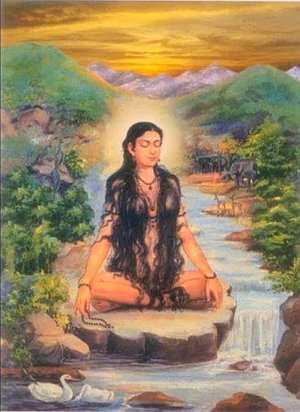
Siddha Srikantha, also known as Sed Bayu or Sed Boyu, was a revered Shaivite saint in 14th-century Kashmir. He played a pivotal role in the spiritual journey of Lal Ded (also known as Lalleshwari), a mystic poetess whose teachings and poetry have had a lasting impact on Kashmiri culture and spirituality.
Siddha Srikantha was a prominent figure in the Kashmir Shaivism tradition, particularly the Trika school, which emphasizes the unity of the individual soul (jiva) with the universal consciousness (Shiva). As a Shaivite guru, he imparted teachings that focused on inner realization and the transcendence of ritualistic practices. His approach encouraged direct personal experience of the divine, aligning with the core principles of Kashmir Shaivism.
Born around 1320 in Pandrethan near Srinagar, Lal Ded was married at the age of 12, as was customary. Her marriage was reportedly unhappy, leading her to leave her home at around 24 to pursue a spiritual path. She became a disciple of Siddha Srikantha, under whose guidance she delved deeply into the practices of Kashmir Shaivism. Lal Ded's spiritual journey was marked by intense personal experience and realization, which she expressed through her poetry, known as "Vakhs."
The relationship between Siddha Srikantha and Lal Ded was foundational to her spiritual development. Under his mentorship, she embraced the teachings of Kashmir Shaivism, focusing on the inner self and the realization of the divine within. This guidance led her to renounce worldly attachments and societal norms, including clothing, as she wandered and recited her mystical poetry. Her verses often challenged established religious practices and emphasized the importance of personal spiritual experience over ritual.
Lal Ded's teachings and poetry have had a profound influence on both Hindu and Muslim traditions in Kashmir. Her emphasis on inner realization and the unity of existence resonated with the Sufi traditions, leading to a syncretic spiritual culture in the region. Notably, she is said to have influenced Sheikh Noor-ud-din Wali (Nund Rishi), a prominent Sufi saint, further bridging the gap between different religious communities.
The spiritual relationship between Siddha Srikantha and Lal Ded exemplifies the transformative power of the guru-disciple dynamic in the pursuit of self-realization. Their connection not only shaped Lal Ded's personal journey but also contributed to a broader spiritual and cultural synthesis in Kashmir, the effects of which are still felt today.
As I reflect on the relationship between Siddha Srikantha and Lal Ded, I find myself deeply moved by the way a single encounter with a realized being can reshape a life, a culture, and perhaps even a cosmos. My own journey, while far removed from the 14th-century mysticism of Kashmir, resonates with the same yearning for truth that compelled Lal Ded to abandon societal norms in pursuit of inner realization.
One of her verses, translated from Kashmiri, strikes me like a bell in the silent temple of the soul:
"Shiva abides in all that is, everywhere; Then do not distinguish between a Hindu and a Muslim. If you are wise, know yourself. That is true knowledge of the Lord."
This wisdom feels timeless. In it, I hear not only Lal Ded's voice but echoes of my own teachers—Sri Ramana Maharshi’s stillness, Nisargadatta’s fierce clarity, and Yogananda’s devotional ecstasy. It reminds me that true spirituality transcends form and dogma. Siddha Srikantha’s role, it seems, was to offer her the key—to open a gate she herself would walk through with fierce grace and fearless expression.
I think often about the courage it must have taken for Lal Ded to walk the streets, clothed only in the divine presence, chanting poems that struck at the root of religious hypocrisy and awakened hearts. It’s not just poetic courage—it’s spiritual audacity. And perhaps that’s what I long to cultivate more of in my own life.
She said:
"I set out in hope of flowers, But the forest had nothing green. In despair, I sought myself, And there I found the bloom eternal."
Her words stir in me the same trembling recognition that comes when I sit quietly and listen for the presence within. What better flower could bloom in the soul’s inner garden than this self-knowing? And yet, how often I wander outward, forgetting what she—and so many mystics—have shouted from the mountaintop: Turn within.
It’s no accident, I believe, that her teacher is remembered as Siddha Srikantha. “Siddha” implies the realized one—the master not merely of scripture but of Being. And through Lal Ded, Srikantha’s teachings didn’t just ripple out—they roared, infused in the songs of a wandering mystic who became an icon of transcendence.
If you feel moved by Lal Ded’s story, let her poetry be more than a distant echo. Let it be a whisper in your heart, reminding you to seek the sacred not in temples or books alone, but in the mirror of your own being. Like her, may you find the courage to step beyond form and find the formless within.
Do you have a spiritual teacher, or someone who awakens the deeper truth in you? Reflect on that relationship. What are they pointing to? And are you ready, like Lal Ded, to walk fearlessly into the unknown in search of that which has always been with you?
Let us walk together—not to worship the footsteps of our teachers, but to seek what they sought; to live what they lived.