Last Modified (on the server side): Tue Apr 29 17:55:18 2025 GMT
Homage to one of many Masters: Science, Spirit, and the Sacred Memory of Sri Aurobindo
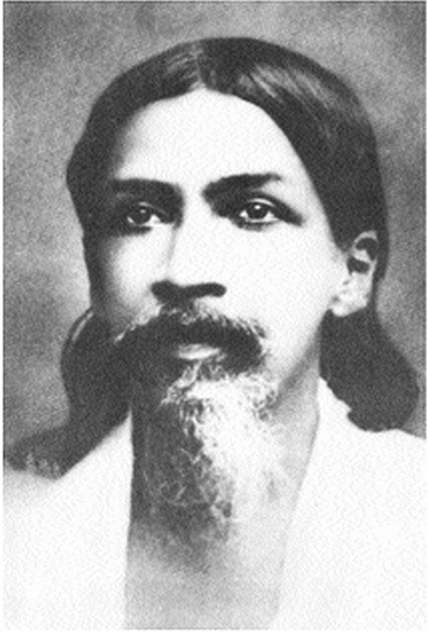
Sri Aurobindo (1872-1950)
On December 9, 1950, four days after the passing of Sri Aurobindo, the Mother (Mirra Alfassa) penned one of the most profound devotional statements in the history of modern mysticism. Addressed to the material body of Sri Aurobindo—still lying in state at the Ashram in Pondicherry—the message reads:
“To Thee who hast been the material envelope of our Master, to Thee our infinite gratitude; before Thee who hast done so much for us, who hast worked, struggled, suffered, hoped, endured so much, before Thee who hast willed all, prepared, achieved, all for us, before Thee we bow down and implore that we may never forget, even for a moment, all we owe to Thee.”
These words move beyond the boundaries of mere eulogy. They represent a living bridge between the visible and the invisible, between the outer vehicle and the inner reality, between the ephemeral and the eternal. For those of us who walk a path that unites the discoveries of science with the wisdom of spirit, this message offers more than homage; it offers insight into the very nature of consciousness and form.
Sri Aurobindo, a towering intellect and mystic, dared to envision human evolution as something more than biological. For him, it was psychological, spiritual, and ultimately supramental—a convergence of inner and outer transformation. Just as quantum physicists have challenged the notion of a mechanistic universe, replacing it with a reality that is probabilistic, participatory, and deeply interwoven with observation and awareness, Sri Aurobindo challenged our view of human limitations. He posited that the next step in evolution would be an awakening to the divine consciousness latent within matter itself.
In this light, the Mother’s words to his material body carry a resonance that transcends religion or doctrine. They recognize the body not merely as a biological shell, but as a vessel of transformative will, a "material envelope" charged with a divine experiment. It echoes with contemporary physics' growing acknowledgment that matter and consciousness may not be separate at all—that there may be, as some theories suggest, a quantum entanglement of spirit and substance.
The Mother’s statement can be understood as an invocation to remember: not merely to recall the person Sri Aurobindo was, but to remain conscious of the divine intention that animated him. This is not a sentimental remembrance; it is a scientific and spiritual imperative. For those of us who believe that consciousness is the missing link in the grand equation of reality, Sri Aurobindo’s life—and even his death—serves as a living symbol of that hypothesis in action.
As we bow before the memory of this master, we are reminded that our own bodies, too, are material envelopes of something infinite. The Mother’s words do not merely glorify one being; they awaken us to the universal destiny we share—to become conscious instruments of the divine Will, bridging spirit and matter in every cell of our being.
In the end, science and spirituality do not contradict each other in this vision; they converge. The great experiment is not only out there in the cosmos or within the particle accelerator. It is also in here, within us. As Sri Aurobindo and the Mother taught, the laboratory of transformation is the human soul and the human body.
May we never forget, even for a moment, all we owe to them—and all we are called to become.